Thesis
Design systems don’t fail because of missing components.
They fail because they never manage to transform team behavior.
For years, the solution always seemed to be the same:
more components, more documentation, more rules.
But even technically correct systems eventually started fragmenting.
Parallel variants appeared, components became duplicated, exceptions multiplied. And teams eventually stopped depending on the system.

The system existed.
The organizational behavior never changed.

The failure that changed everything
In 2016, I built one of my first design systems without clear references for adoption, governance, or scalability.
The goal seemed simple:
create consistency.
The components existed.
The rules were defined.
The system was structured.
But teams only used it when they wanted to.
Decisions continued happening outside the shared logic. Each team reinterpreted the system according to its own needs.
The problem wasn’t visual.
It was behavioral.
The question that changed everything
What makes a team depend on a system instead of ignoring it?
Because true adoption doesn’t happen when people use components.
It happens when the system changes how teams make decisions, collaborate, and scale product in a coordinated way.
Design systems don’t scale through components.They scale through organizational behavior.
The model
From that observation, a recurring pattern began to emerge across teams and organizations.
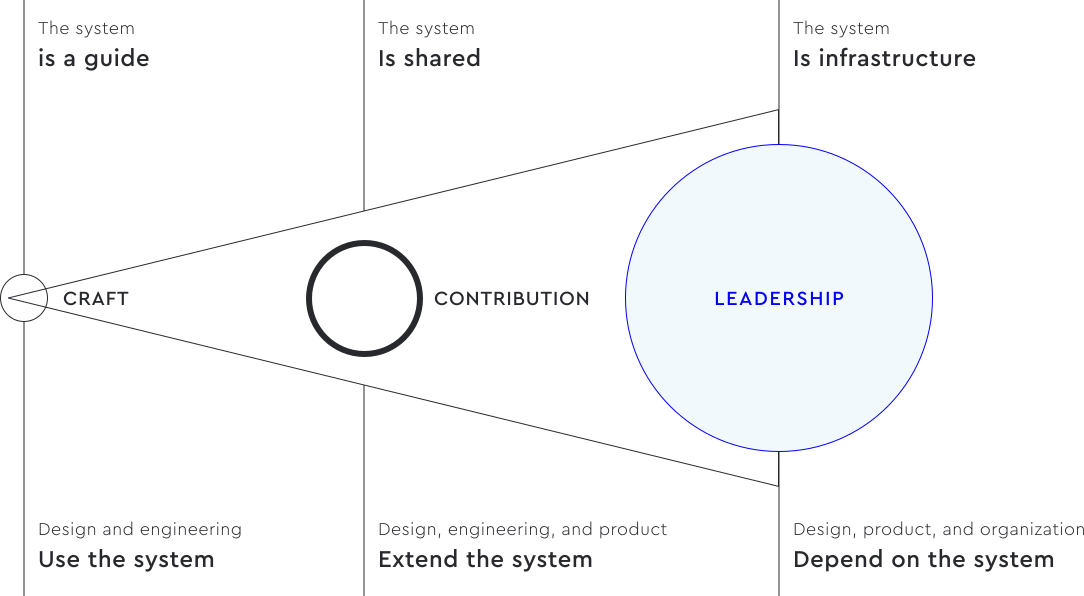
Mature adoption happens through three stages:
- Craft
- Contribution
- Leadership
The progression is not technical.
It’s behavioral.
Craft
At the Craft stage, teams use the system as guidance.
Design and engineering share components, patterns, and visual decisions.
Coordination happens through specific people and local agreements.
The system helps reduce inconsistencies, but it still does not structure how the organization makes decisions.
El sistema existe.
Pero aún es opcional.
Contribution
At the Contribution stage, the system stops being only a library maintained by a central team.
Teams begin extending it, documenting it, and participating in its evolution.
Product enters the conversation.
Decisions stop being purely visual and begin coordinating priorities, constraints, and shared needs.
The system stops belonging to a single team.It becomes shared responsibility.
Leadership
At the Leadership stage, the system stops functioning as a UI tool.
It becomes organizational infrastructure.
Design, product, and the organization depend on it to coordinate speed, consistency, and operational scalability.
The system no longer exists only to build interfaces.It exists to align decisions.
The organization stops asking whether it should use the system.
Working outside the system becomes more expensive than working within it.
How systems collapse
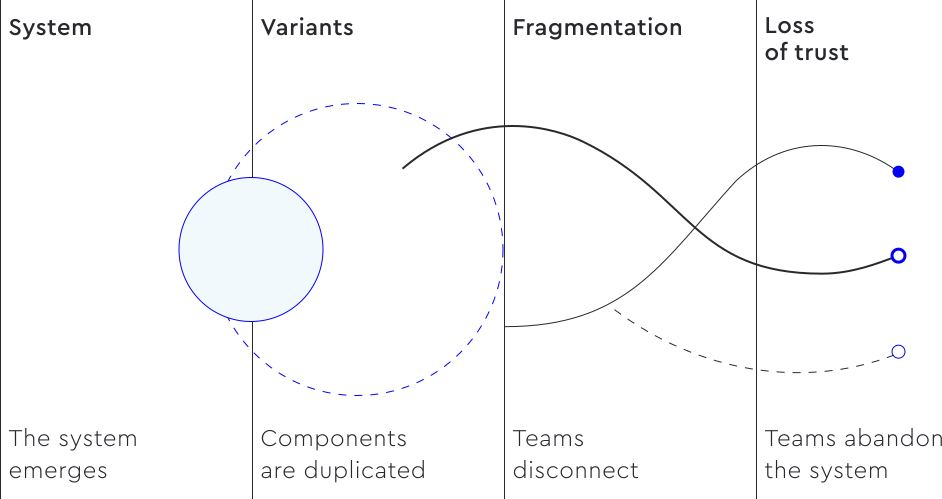
Most systems do not collapse suddenly.
They degrade progressively.
First, parallel variants appear.
Then duplicated components.
Then local exceptions.
Eventually, teams stop trusting the shared logic and begin solving problems outside the system.
Systems rarely disappear completely.
They lose coordination until they stop being reliable.
System maturity framework
System adoption does not happen only at the organizational level.
It also transforms the relationship each designer has with the system as their participation matures over time.
The progression evolves from operational usage to organizational leadership.
Operational use of the system
LEVEL 1
SYSTEM FOUNDATIONS
- Uses system components
- Applies design tokens
- Follows grid systems
LEVEL 2
STRUCTURED DESIGN
- Uses states and variants
- Avoids unnecessary duplication
- Maintains atomic hierarchy
LEVEL 3
SCALABLE THINKING
- Designs for reusability
- Reduces component entropy
- Optimizes component variants
Shared evolution of the system
LEVEL 1
SYSTEM OPERATOR
- Uses the latest libraries
- Reports issues
- Documents implementation
LEVEL 2
SYSTEM CONTRIBUTOR
- Proposes system improvements
- Adds components
- Documents patterns
LEVEL 3
SYSTEM STEWARD
- Audits system adoption
- Maintains component health
- Defines contribution workflows
Organizational scalability of the system
LEVEL 1
SYSTEM FACILITATOR
- Promotes system adoption
- Facilitates onboarding
- Drives system adoption
LEVEL 2
INTEGRATOR
- Connects design and engineering
- Coordinates product teams
- Identifies reuse opportunities
LEVEL 3
SYSTEM ARCHITECT
- Defines system vision
- Establishes cross-functional governance
- Aligns design, engineering, and product
- Integrates the system into organizational strategy
Behavioral evidence
Each level represents observable behavior within the system, not only technical knowledge.
Progression happens when designers stop simply using the system and begin contributing, coordinating, and scaling their impact across the organization.
Examples of behavioral evidence:
Craft
- Consolidation of redundant variants.
- Optimization of reusable structures.
- Consistent application of tokens and patterns
Contribution
- Adoption audits.
- Documentation of reusable patterns.
- Definition of contribution workflows.
- Component health management.
Leadership
- Cross-functional coordination between design, engineering, and product.
- Definition of system governance.
- Alignment between organizational strategy and system scalability.
- Integration of the system into operational processes.
Where it works and where it doesn’t
This model works best when there is:
- A system with a certain level of maturity.
- Teams with sufficient operational scale.
- Real coordination and reuse needs.
In smaller projects or individual teams, the progression does not happen in the same way.
Adoption requires:
- Time.
- Real friction.
- Shared decisions the system can absorb.
Final insight
A design system is not a component library.
It is a human alignment system at scale.
The difference between a system that scales and one that collapses is not in the tokens, documentation, or components.
It lies in the moment when the system stops being optional and becomes the most efficient way to work.